
99 Nights in the Forest Script No Key for Mobile & Guide
99 Nights in the Forest Script
Latest 99 Nights in the Forest Scripts
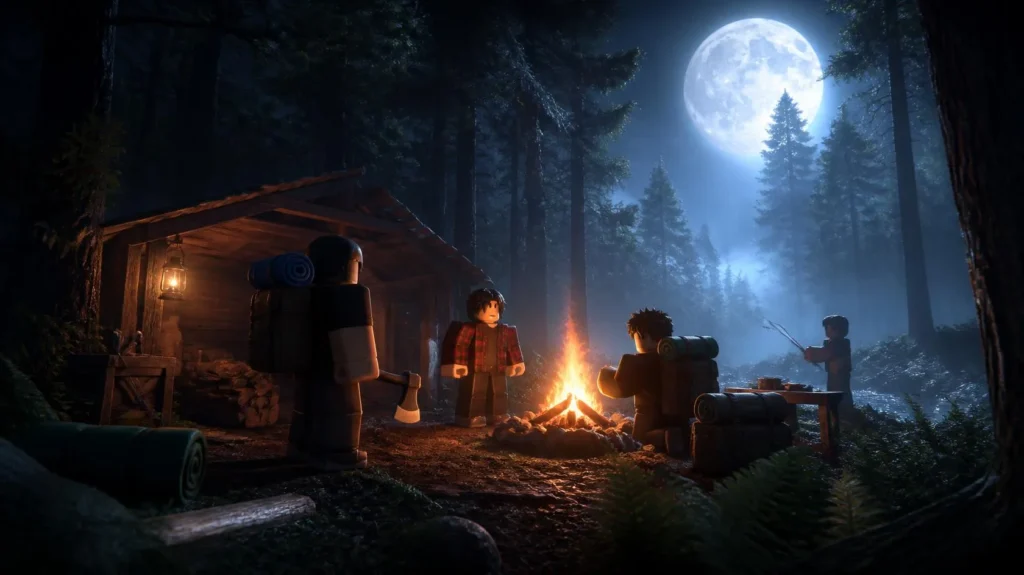
In 99 Nights in the Forest, players must survive 99 nights while managing resources, upgrading the Campfire, exploring the forest, and rescuing missing children. Players also need to craft equipment, choose useful classes, find food, and defend themselves against different enemies. As the nights become harder, effective resource management and teamwork become more important, especially during multiplayer gameplay. The main goal is to use the right survival strategy, manage resources carefully, and make it through all 99 nights.
99 Nights in the Forest
99 Nights in the Forest is a Roblox survival-horror game where players begin with limited resources, build a camp, and explore the forest. The game features 40 classes, over 100 items, multiple biomes, and different progression systems that may change with updates. The main goal is to survive 99 nights while finding and rescuing four missing children hidden inside dangerous caves. Good preparation, resource gathering, and understanding enemy behavior are essential for surviving longer in the forest.
How 99 Nights in the Forest Works
The basic gameplay loop can be divided into four stages:
- Daytime – Gather wood, food, materials, and useful equipment.
- Preparation – Upgrade the Campfire, craft items, organize resources, and prepare defenses.
- Nighttime—Stay close to safety when necessary and survive hostile entities.
- Progression – Explore farther, rescue children, improve equipment, and prepare for later nights.
At night, staying safe from hostile entities is important while exploring, rescuing children, and improving equipment for later nights.
Main Gameplay Features of 99 Nights in the Forest
| Feature | Main Purpose | Why It Matters |
| Campfire | Base and nighttime safety | Supports survival and exploration |
| Resource Gathering | Collect materials | Needed for crafting and upgrades |
| Crafting | Create useful equipment | Improves survival |
| Classes | Provide unique perks | Changes your playstyle |
| Exploration | Discover locations and loot | Provides better resources |
| Child Rescue | Complete major objectives | Important for progression |
| Combat | Defeat hostile enemies | Protects players and camps |
| Food | Manage hunger | Keeps players prepared |
| Beds | Improve progression efficiency | Helps advance through days |
| Biomes | Add different environments | Change exploration and threats |
99 Nights in the Forest Scripts
Many Roblox players search for 99 Nights in the Forest scripts to learn about automation, farming, teleportation, and other third-party modifications. These scripts are designed to change or automate certain gameplay actions in different ways. Features can vary between scripts, with some focusing on resource collection, farming, movement, or item management. Since they are not official game features, scripts may stop working or require updates after the game receives a new update.
What Are 99 Nights in the Forest Scripts?
99 Nights in the Forest scripts are third-party code resources that can automate or modify certain gameplay actions. Depending on the script, they may offer features for resource collection, farming, movement, or item management. These scripts are separate from the official Roblox and 99 Nights in the Forest script features. They may also stop working or require updates when the game receives a new update.
Latest 99 Nights in the Forest Scripts
Voidware 99 Nights Script – NO KEY
Foxname Hub — 99 Nights in the Forest Script Mobile PC
BronxWare — 99 Nights in the Forest
Ringta Hub — 99 Nights Edition
H4xScripts — God Mode Script
Delta 99 Nights Script — No Key
Delta Script 99 Nights in the Forest — Speed Hub X GUI
Delta Executor Script 99 Nights in the Forest — VoidWare
Solvex Hub — 99 Nights OP Script Roblox
KRNL Infinte Candy Farm Script 99 Nights
Solara Admin Commands Script
Gec Hub — 99 Nights Script GUI
NOVA Hub — 99 Nights in the Forest Script
H4x 99 Nights Script
99 Nights in the Forest Script CPS Hub
Junkie 99 Nights in the Forest Script Christmas Event
Delta Exploits 99 Nights Script
Delta 99 Nights Script — Vortex Hub
Delta Scripts 99 Nights in the Forest — Horizon Hub
Delta Supported 99 Nights — Vex OP
Delta 99 Nights in the Forest Mobile & PC (No Key)
Delta 99 Nights Roblox Script — Auto (Mobile/PC/Tablet) Keyless
Delta 99 NITF Script — DarkEsc Hub
Delta Script 99 NITF — ToastyXD (No Key)
Delta DarkKONE Script — Mobile GUI
Delta x Script — Gec Hub
Delta Exploits 99 Nights in the Forest
Delta HoHo Hub
Delta PolleserHub
Kill Aura, ESP, Auto Hunger, Auto Items, NoClip
OverFlow Hub
Delta Cat Hub
Delta 99 Nights Hack — FoggyHub
Delta 99 NITF Script
Keyless – Auto Day, Auto Diamond
NTT Hub – Multi-Feature GUI
Halloween Script – Diamonds Aura Chest Farm OP
ToastyXD Hub – Premium Features
Tycoon US Script
Elude Hub
Combo Wick
Auto Diamond, Safe Mode, Anti-Ban
PhantomFlux Script
Delta Scripts – No Key, ESP, Infinite Diamonds
Universal No Key GUI
Kenniel Hub
AutoFarm Diamonds (Keyless)
VoidWare Alternative Version
Kaito Hub
Nagi Hub
LAWSHUB – Visuals, Hitbox, Player Features
Voidware Version 3
Auto Diamonds Minimal
Auto Win, Auto Chest, Teleport
Rift Hub — Auto Farm, Bring Items, Max Days, Diamond Farm
Cobra Hub — Kill Aura, Auto Farm and More
StreeHub — AutoFarm, Mob Aura, ESP, Teleport, Keyless
Somtank Hub
Infinity X
Ringta Script
99NiTF Script
99 Nights Mod
Snow Biome Script
Mobile Fly / ESP / Bring Item
99 Nights Mobile
SpaceHub
99 Nights Hack
Roblox Script
VoidWare Extra
How to survive 99 nights in the forest
Survival becomes easier when you treat each day as time to prepare instead of constantly exploring the forest. During daylight, you have more time to gather materials and explore different areas. As night approaches, it becomes more important to return to camp and prepare your equipment. Good preparation during the day can help you stay safer when darkness arrives.
A good survival routine looks like this:
Gather → Upgrade → Craft → Explore → Return → Defend → Repeat
The first few nights are especially important because they determine how quickly your camp develops.
How to Survive the First Nights
During your first nights, prioritize basic resources instead of travelling extremely far from your Campfire.
Your first objectives should include:
- Collecting wood.
- Finding food.
- Locating useful equipment.
- Upgrading the Campfire.
- Learning the surrounding map.
- Building basic crafting infrastructure.
- Understanding where enemies appear.
- Returning to camp before night becomes dangerous.
How to Gather Resources
Resource gathering is the foundation of almost every successful run. Wood is especially important because it supports Campfire progression and construction needs, while coal, fuel, food, and crafting materials become more useful as your run develops. Instead of collecting resources randomly, create routes by finding nearby areas with useful resource nodes and checking them regularly during the daytime. In multiplayer, divide the work so one player gathers wood, another searches for food, and another explores for equipment.
How to Keep the Campfire Alive
The Campfire is the center of your survival base, and keeping it fueled helps maintain the safe area around camp at night. Higher Campfire levels also support further progression as your run develops. Community guides currently describe six Campfire levels, with later levels requiring more resources. Exact requirements can change with updates and party size, so the in-game crafting interface should be treated as the final authority.
A simple rule is
Do not spend all your early resources on optional items while your Campfire still needs major upgrades.
99 Nights in the Forest Campfire
The Campfire is one of the most important structures in the game, serving as your main base and providing a safer area during nighttime. Upgrading the Campfire can increase your effective exploration range as your run progresses. Keeping it upgraded makes it easier to explore areas farther from your base. This also helps you prepare for longer and more challenging survival runs.
Campfire Levels
The Campfire progresses through multiple levels, with early upgrades requiring manageable resources while later upgrades demand significantly more.
| Campfire Stage | General Purpose |
| Level 1 | Starting camp and basic safety |
| Level 2 | Larger useful area and further progression |
| Level 3 | More exploration and improved camp |
| Level 4 | Access to deeper objectives |
| Level 5 | Advanced progression |
| Level 6 | Endgame preparation and major objectives |
Best Campfire Fuel
Fuel requirements change as the Campfire progresses. Common fuel resources include:
- Wood and Logs
- Coal
- Fuel Canisters
- Biofuel
- Oil Barrels at later stages
Do not wait until the campfire is nearly empty before collecting fuel. Keeping a reserve allows you to react to unexpected situations.
Campfire Defense
A strong Campfire is more than just a light source during your run. It gives players a central place to regroup, recover where applicable, organize inventory, and prepare for the next expedition. Keeping the Campfire well supplied also makes your base more useful between expeditions. When playing with a team, keep important resources near camp instead of scattering them across the map.
How to Protect Your Base
Build your base for efficiency, not just appearance. Keep important crafting structures close and easy to reach, and make sure you always have enough fuel for the Campfire. Ensure everyone can return to the Campfire quickly when things become dangerous. During enemy attacks, avoid chasing enemies without a reason, because staying alive is more important than defeating every enemy.
99 Nights in the Forest Classes
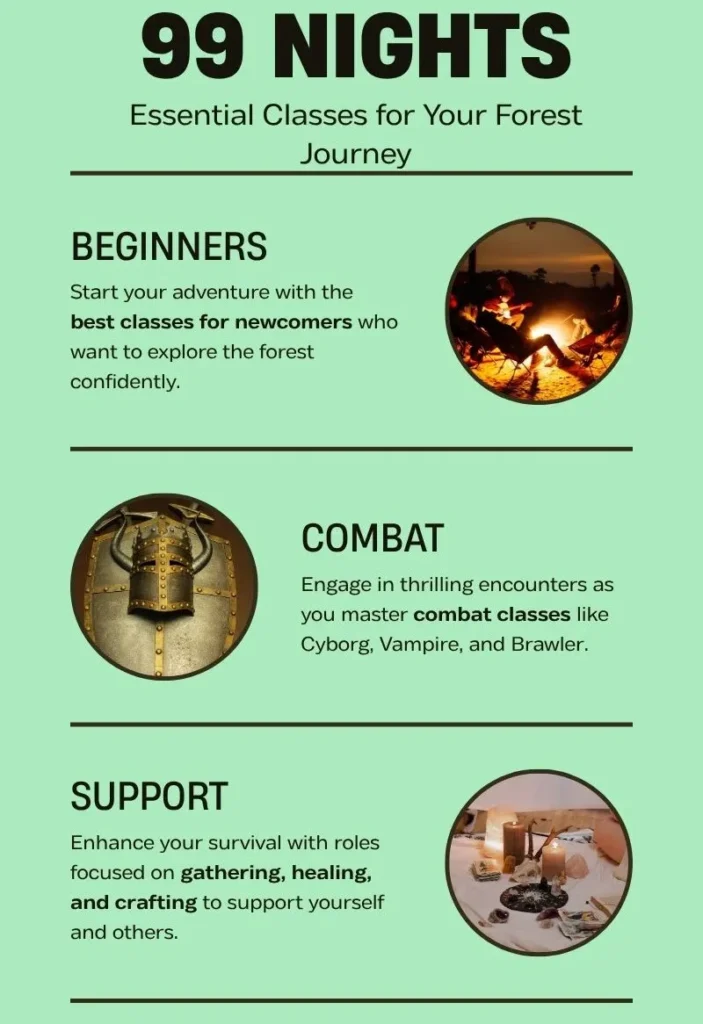
Classes are one of the most important progression systems in 99 Nights in the Forest. Each class can offer unique perks, starting equipment, and abilities that influence how you play through a run. Current guides list more than 35 permanent classes, while newer databases show around 40 as the game continues to receive updates. Classes can usually be upgraded by completing objectives, and many offer three progression levels.
Best Classes for Beginners
Beginners should choose a class that offers useful benefits without making the game harder to understand. Camper is a simple option because it is affordable and provides helpful support during the early game. It gives new players a chance to learn the basics without dealing with complicated class mechanics. Players who prefer combat can later switch to a class designed around fighting.
Best Combat Classes
Combat classes are useful for players who often fight enemies or help protect their teammates. Community guides often mention Cyborg, Vampire, Assassin, Brawler, and Gunslinger for different combat-focused playstyles. Each class has its own strengths, so the best choice depends on whether you prefer damage, mobility, defense, ranged attacks, or utility. Choosing a class that matches your preferred fighting style can make combat feel much easier.
Best Support Classes
Support classes can be very useful when playing with others because they give the team more ways to handle different situations. Instead of having everyone focus on damage, players can take different roles such as resource gathering, combat, healing or sustain, and exploration. Other useful roles include base defense and specialized crafting, depending on what the team needs. Having players with different roles makes the group more flexible and better prepared for each survival run.
Best Solo Classes
Solo players should focus on classes that help them stay independent throughout the run. A class that reduces resource pressure can be more useful when there is no teammate to help with gathering. Better survivability or useful combat tools can also make a big difference for solo players. Because of this, independent classes are often a better choice than highly specialized team-support classes.
99 Nights in the Forest Weapons
Weapons are essential when you need to defend yourself against hostile creatures or enemy groups. The right weapon depends on your class, available resources, and whether you are playing solo or with teammates. Choosing a suitable weapon can make it easier to handle enemies and stay safe throughout your run. Your playstyle and current situation should also guide which weapon works best.
Melee Weapons
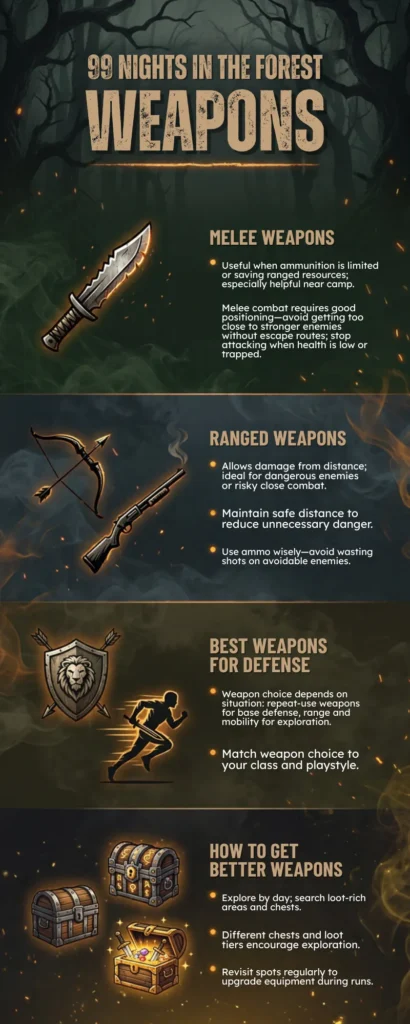
Melee weapons are useful when ammunition is limited or you want to save ranged resources. They are especially helpful against enemies that get close to your camp. Melee combat still requires good positioning, so avoid getting too close to stronger enemies without a safe escape route. Do not keep attacking powerful enemies if your health is low or you have no clear way to escape.
Ranged Weapons
Ranged weapons let you damage enemies while keeping a safe distance from the target. They are especially useful against dangerous enemies or situations where getting close would be risky. Keeping your distance can help you handle threats without putting yourself in unnecessary danger. Avoid wasting ammunition on enemies that you can safely leave alone.
Best Weapons for Defense
The best weapon depends on what you are doing and the situation you are facing. For base defense, reliable weapons that can be used repeatedly are a practical choice. During exploration, weapons with good range and mobility may be more useful. Your class should also play a role when deciding which weapon best fits your playstyle.
How to Get Better Weapons
Explore during the day and search areas that contain loot and chests. Different chest types and loot tiers give you more reasons to explore when looking for better equipment. Checking these locations regularly can help you find useful weapons during your run. Exploration is an important way to improve your equipment and obtain better weapons.
99 Nights in the Forest Crafting
Crafting transforms collected resources into equipment that can make survival easier. Instead of spending every material immediately, consider what your team needs most.
How Crafting Works
Crafting generally follows a simple process:
Gather materials → unlock/use crafting station → select item → create equipment
As your Campfire and crafting infrastructure improve, additional options become available.
Best Early-Game Items
Early-game priorities usually include items that help you:
- Gather resources faster.
- Maintain the Campfire.
- Find food.
- Defend yourself.
- Store or transport resources.
- Explore safely.
Do not spend rare materials on unnecessary items if your team still lacks essential survival equipment.
Crafting Weapons
Weapons should be crafted when they solve an immediate problem. If your team already has enough weapons, additional resources may be better spent on Campfire progression or base improvements.
Crafting Camp Defenses
Defensive structures become more valuable as enemy pressure increases. A well-organized base helps players respond quickly to attacks without wasting time searching for equipment.
Food and Cooking
Food is another key part of preparation. Keeping enough food available before an expedition reduces the risk of having to return early.
99 Nights in the Forest Solo vs Multiplayer
99 Nights in the Forest can feel different when playing alone compared with a team. Solo players must manage more tasks on their own, while teams can divide responsibilities and handle challenges together. Your strategy should match whether you are playing solo or with teammates.
| Playstyle | Advantages | Challenges |
| Solo | Full control over resources | Every task depends on you |
| 2 Players | Easy communication | Limited role coverage |
| 3 Players | Stronger specialization | Requires coordination |
| 4 Players | Excellent role distribution | Resource sharing is important |
How to Survive 99 Nights in the forest
The easiest way to think about a 99-night run is through stages.
Early Game
During the early game, establish your foundation.
Your priorities should be:
- Upgrade the Campfire.
- Gather basic resources.
- Find food.
- Obtain useful equipment.
- Learn nearby enemy patterns.
- Build basic infrastructure.
Do not rush deep into the forest before your camp is ready.
Mid Game
The mid game is where your earlier preparation begins paying off.
You should have:
- A stronger Campfire.
- Better equipment.
- Better resource routes.
- More food.
- Improved crafting options.
- A clearer understanding of the map.
- A plan for child rescues.
At this stage, begin taking more calculated risks.
Late Game
Late-game survival is mainly about consistency and avoiding unnecessary mistakes. Once you understand the basic mechanics, focus on keeping your Campfire supplied, maintaining equipment, and managing food. When playing with teammates, stay coordinated so everyone knows their role and responsibilities. The goal is not to win every encounter, but to survive until the next morning.
Nights in the Forest Tips and Tricks
Here are some practical strategies that can improve almost any run.
Upgrade the Campfire Early
Your Campfire determines how safely and how far you can progress. Early Campfire upgrades should usually be a major priority.
Gather Before You Need the Resource
Do not wait until your Campfire is nearly empty before collecting fuel.
Use Daylight Efficiently
Every daytime period is an opportunity to gather, explore, and prepare.
Don’t Fight Everything
Avoiding a dangerous enemy is often better than wasting health and ammunition.
Learn Entity Behavior
The Deer, Cat, Bat, Owl, Ram, Cultists, and Boars do not all behave the same way. Learning the correct response for each threat is more effective than using one strategy against everything.
Keep an Emergency Supply
Reserve food, fuel, healing items, and weapons for unexpected situations.
Don’t Wander at Night
If you don’t have a specific reason to travel, stay near your Campfire.
Coordinate With Your Team
Four players doing the same task is usually less efficient than four players performing different jobs.
Choose Your Class Carefully
Your class should complement your preferred role rather than simply being the most expensive option.
Rescue Children When Prepared
Child rescues are important, but rushing into a cave without suitable equipment can end your run.
Keep Your Inventory Organized
Knowing exactly where your essential resources are saves time when danger arrives.
Prepare Before Every Night
A quick pre-night inventory check can prevent many avoidable deaths.
Frequently Asked Questions
What is 99 Nights in the Forest?
99 Nights in the Forest is a Roblox survival-horror game where players gather resources, build and upgrade their Campfire, explore dangerous areas, fight or avoid enemies, rescue missing children, and survive through 99 challenging nights.
How many nights do you need to survive?
The main survival objective is to reach Night 99.
What is the Campfire used for?
The Campfire is the heart of your base. It creates a safer area at night and can be upgraded to support exploration, resource gathering, and overall progression.
Can you play 99 Nights in the Forest solo?
Yes, solo play is possible, but you must manage gathering, crafting, combat, exploration, and Campfire tasks yourself. Multiplayer makes survival easier by allowing players to divide responsibilities and work together.
What should you do during the first night?
Focus on gathering basic resources, keeping the Campfire supplied, finding useful equipment, and learning the nearby area instead of travelling too far from your base.
Is the Campfire more important than exploration?
Early in a run, usually yes. A stronger Campfire provides a better foundation for later exploration and child-rescue objectives.
What is the best way to survive The Deer?
Avoid treating The Deer like a normal boss. Stay aware of your position, use the Campfire’s safe area, and learn its behavior instead of trying to defeat it directly.
What are the main biomes in 99 Nights in the Forest?
Current community references identify Forest, Deep Forest, Snow, Volcanic, and Jungle environments. The Jungle adds extra threats, including The Cat.
Final Thoughts
99 Nights in the Forest is easier to understand as a progression system built around preparation and smart choices, rather than simply surviving 99 nights. Strong runs involve gathering resources during the day, upgrading the Campfire, crafting useful equipment, and exploring when it is safe. Classes allow players to focus on combat, exploration, gathering, defense, or support, while the four missing children provide long-term goals that encourage further exploration. With a strong Campfire, suitable class, organized resources, and good equipment, you can avoid unnecessary risks, make steady progress, and reach Night 99 more easily.